14 |
drinkanddrugsnews
| October 2015
MOVING FORWARD
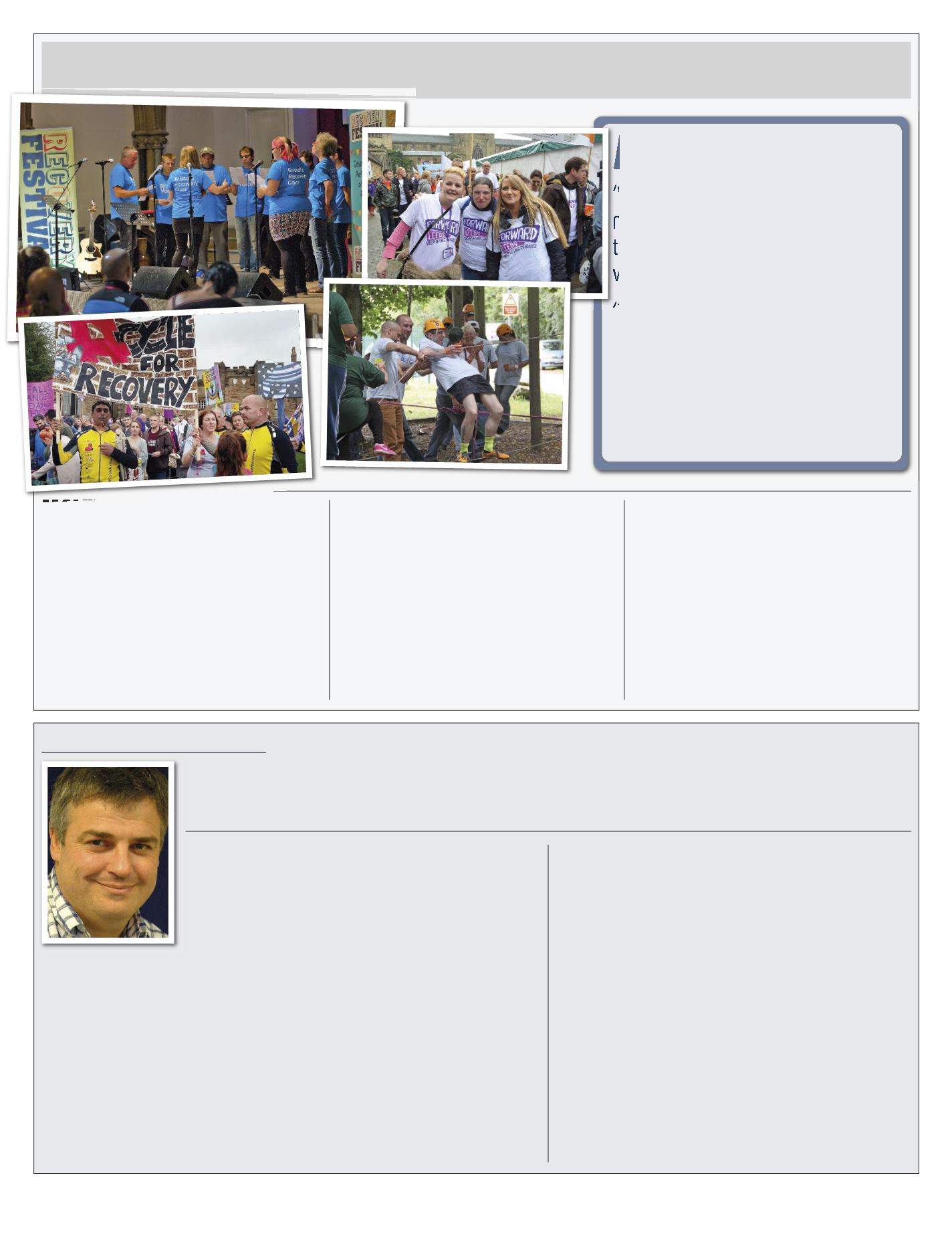
FORWARD LEEDS staff, volunteers and service users
also attended the UK recovery walk to meet and
connect with the local recovery community. The walk
led crowds through the city centre, past Durham
Cathedral, and provided live music, stalls and activities
– as well as a performance by the UK recovery choir
and rap artist Ben SoS Riley.
The Le Tour de Recovery also joined the walk, after
cycling to Durham from Leamington Spa. The ride
raised money for UK FAVOR, as well as awareness for
the importance of communities sustaining recovery.
FESTIVAL FEELING
Jack Hall of Bristol Drugs Project
shares what went down at the third
recovery festival
THIS YEAR’S FESTIVAL captured its biggest audiences
ever, with attendees from recovery communities
across the south west.
Established in 2013, the recovery festival is a free
annual event that celebrates recovery from addiction by
bringing people together to share their strengths, hopes,
achievements and, most importantly, their talents.
This year’s festival featured an array of local
musicians, as well as fantastic performances by Bristol’s
recovery choir Rising Voices and the Bristol Drugs
Project theatre group. Topping the line-up were guest
speakers Annemarie Ward, founder of the UK recovery
walk, and Tony Mercer of Public Health England.
The day featured a selection of great food and
refreshments, as well as alternative therapies, taster
support groups, and the opportunity to browse the
stalls of local communities and services to find out
what opportunities are available to people thinking
about treatment, or in recovery.
InsIghts
‘We do get better... you would
never believe that the person next
to you could ever have had issues
with substances.’
neil FiRbAnk
‘the recovery festival... celebrates
recovery from addiction... bring-
ing people together to share
their strengths, hopes, achieve-
ments and, most importantly,
their talents.’
JAck HAll
RECOVERY MONTH...RECOVERY MONTH
POST-ITS FROM PRACTICE
MARCO RARELY CAME TO THE SURGERY
. He was a 44-year-old
restaurant owner with two young children but on a routine screen
had been picked up as having high blood pressure. He had been given
advice to lose a little weight and exercise more, but this made no
significant difference. He was started on an anti-hypertensive and his
blood pressure improved; but 12 months later it was up again, and as
he was adamant he was taking his medication every day, a second
drug was added in.
Three months later one of our registrars noticed his blood
pressure was again poorly controlled. Rather than add in a third drug
she decided to discuss this with me as part of her learning portfolio.
We went through his notes. He had been overweight but his body
mass index (BMI) was now 26, so this was unlikely to be a significant
factor. He had stopped smoking when his first child was born seven
years earlier, his renal function was normal and no significant past
medical history was recorded. I asked her if he drank alcohol. ‘I’m not
sure,’ she said and indeed nothing was recorded in his notes about
alcohol consumption. I explained that excessive alcohol use was a
major factor for hypertension and cardiovascular disease.
He was due for review the following week and after this we caught
up. He had told her he drank a bottle of red wine every day, as it was
good for his heart! She had explained to him about the effect alcohol
has on high blood pressure and cardiovascular disease and he had been
shocked by this. He decided to try and cut his alcohol down rather than
take a third medication. His blood pressure improved over the next few
weeks and it was possible to stop one of his tablets.
I was the next person to see him and this time his blood pressure
was within the normal limits while he was still taking a single drug
to control it. He told me he had reduced his alcohol to half a bottle
one night during the week and half a bottle each day over the
weekend.
I wonder how many patients have physical and mental health
problems related to their drug or alcohol use that pass unnoticed
because a health professional doesn’t ask. We are trained to ask
difficult and/or embarrassing questions, yet so often we don’t.
As part of our commitment to improving the treatment of alcohol
users, SMMGP have launched an online training module about the
community management of alcohol use disorders which can be
completed free of charge at
Steve Brinksman is a GP in Birmingham and clinical lead of SMMGP,
He is also the RCGP regional lead in substance
misuse for the West Midlands.
A BREATHOF FRESH AIR
Sometimes the drug or alcohol problem isn’t obvious, says
Dr Steve Brinksman
‘We are
trained to
ask difficult
and/or
embarrassing
questions,
yet so often
we don’t..’


